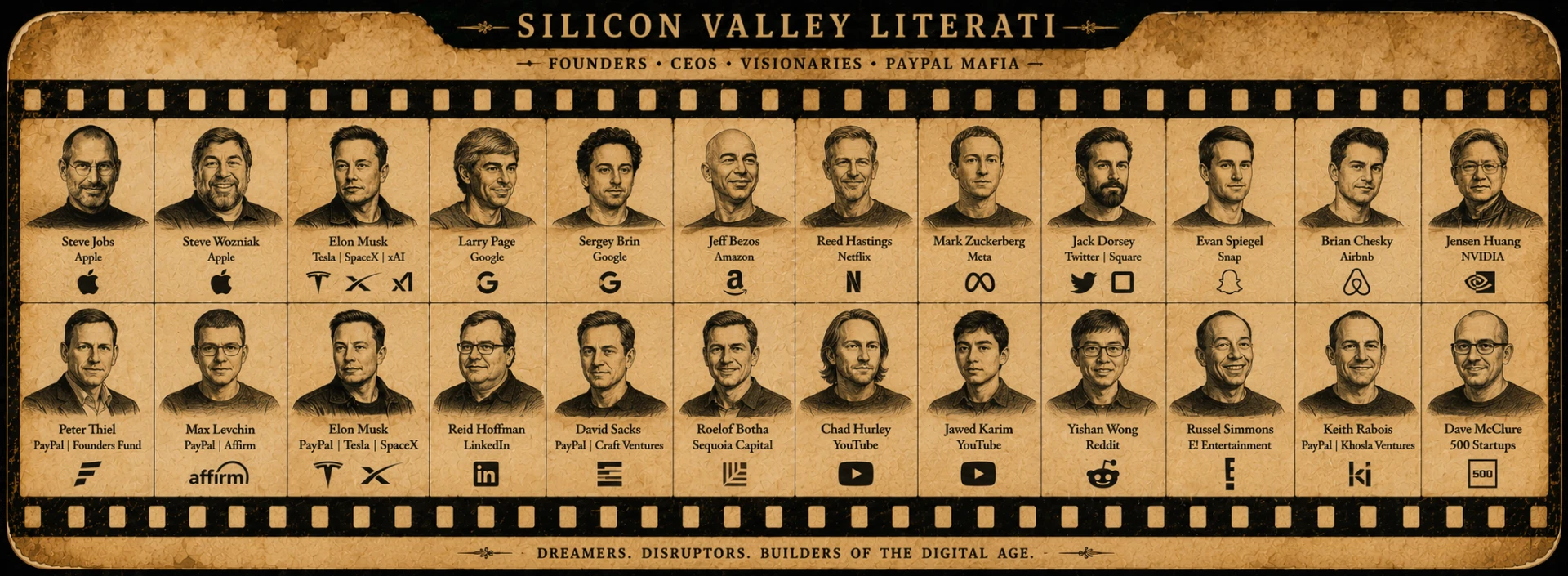
Founders · CEOs · Visionaries · PayPal Mafia — Dreamers. Disruptors. Builders of the digital age.
🌉 Silicon Valley Stories
The people, companies, accidents, betrayals, bets and breakthroughs that built the future.
Not a dry history of Silicon Valley—but storytelling as leadership education. Each story can be a compact, beautifully designed “case study” with a leadership lesson.
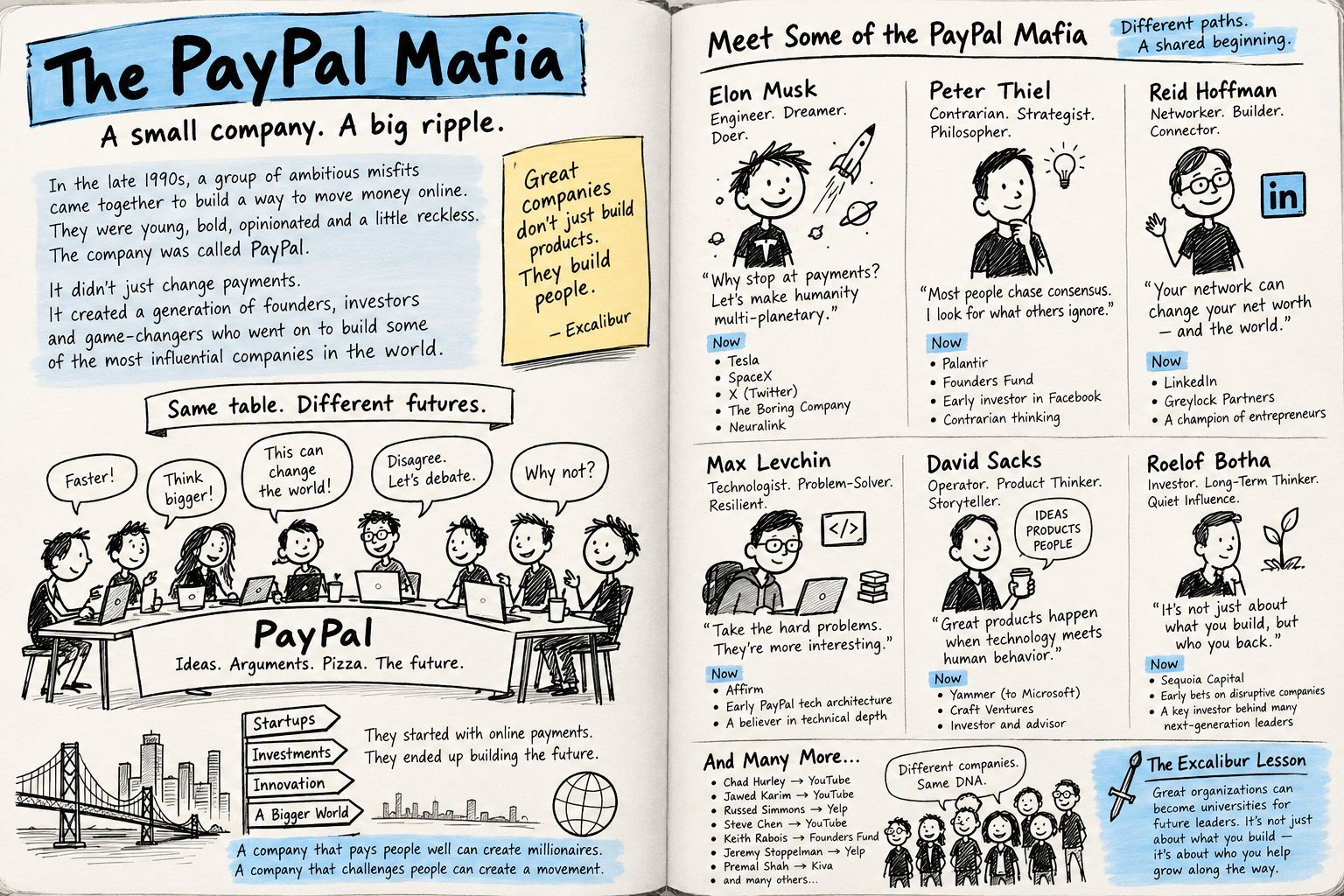
🅿️ The PayPal Mafia
The ultimate origin story. A company that produced an extraordinary constellation of future founders and investors.
- → Elon Musk — X.com, PayPal, and what came after 🚀
- → Peter Thiel — contrarian thinking 🧠
- → Reid Hoffman — LinkedIn and networks 🤝
- → Max Levchin — technology and resilience
- → David Sacks — entrepreneurship and operating systems
- → Roelof Botha — the venture-capital lineage
⚔️ The Excalibur Lesson
Great organizations can become universities for future leaders.
🍎 Steve Jobs & the Renaissance of Silicon Valley
One of the greatest stories ever told in business.
⚔️ The Excalibur Lesson
Sometimes exile is preparation for greatness.
🏠 The Google Story
Two Stanford students, a better search algorithm—and then:
⚔️ The Excalibur Lesson
Create organizations that can think beyond their current business.
🟦 Facebook: The Dorm Room to the World
Not merely a startup story—but a story about speed, scale and consequences.
⚔️ The Excalibur Lesson
Move fast—but understand what happens when you reach billions.
🎬 Pixar, Steve Jobs & the Long Game
Jobs bought Pixar for what initially looked like a very bad investment.
Years of struggle → technological persistence → storytelling magic → one of the greatest corporate success stories.
⚔️ The Excalibur Lesson
Some of the greatest assets look like failures before they mature.
📦 Amazon: Day 1
The garage, the door desks, the early losses, relentless customer obsession.
⚔️ The Excalibur Lesson
Great companies institutionalize their founder's mindset.
💳 The Visa–PayPal–LinkedIn–Tesla–YouTube Network Effect
A fascinating “Silicon Valley family tree” page could show:
PayPal → LinkedIn → YouTube → Yelp → Tesla → SpaceX → Palantir → Yammer → Affirm → Founders Fund → countless more
This could be a spectacular visual centerpiece for Excalibur. 🌳
⚔️ The Excalibur Lesson
Networks compound. Today's alumni become tomorrow's ecosystem.
🔥 Other Stories Worth Building
🏛️ A Great Structure for the Excalibur Page
Legends. Failures. Pivots. Betrayals. Comebacks.
⚔️ Every story ends with THE EXCALIBUR LESSON
What can leaders learn from this?
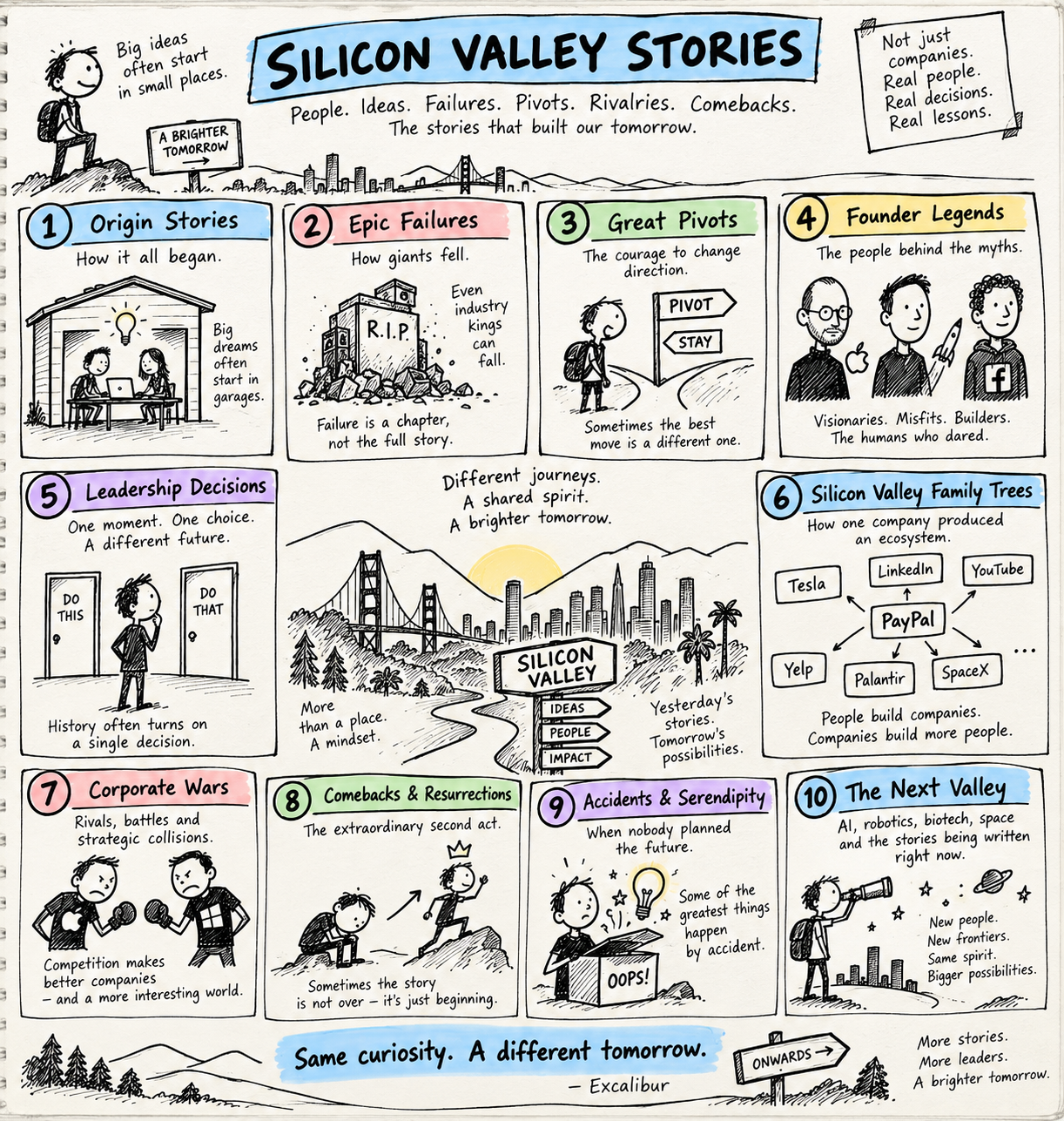
🚀 Origin Stories
Where the impossible began
🅿️ The PayPal Mafia: A Company That Became an Ecosystem
PayPal was far more than a payments company. Its early years brought together an unusual concentration of ambitious people—engineers, founders, investors and contrarians—who would later scatter across Silicon Valley and build some of the most influential companies of the next generation. The organization became an informal academy of entrepreneurship.
What makes the PayPal story remarkable is what happened after people left. The alumni network went on to shape companies and investment firms across technology, media, electric vehicles, social networks and venture capital. The lesson is profound: occasionally, the greatest product of an organization is not what it sells—it is the people it develops. 🌐
⚔️ The Excalibur Lesson
Build organizations that produce leaders, not merely employees.
🍎 Apple: Two Friends, a Garage and a Personal Computer
The Apple origin story has become almost mythical: Steve Jobs and Steve Wozniak combining two radically different talents. Wozniak represented extraordinary engineering brilliance; Jobs possessed an instinct for products, storytelling, design and the future.
The deeper lesson is that revolutionary companies are often born from complementary minds. One person may know how to build something. Another may know why the world should care. Innovation frequently happens at that intersection.
⚔️ The Excalibur Lesson
Vision without execution is imagination. Execution without vision is machinery. Greatness needs both. 🍎
🔎 Google: Organizing the World's Information
Google began with a deceptively audacious ambition: organize the world's information and make it useful. Larry Page and Sergey Brin did not simply build another search engine; they approached the problem with a different way of measuring relevance.
The deeper story is about intellectual courage. Great companies often begin by challenging an assumption everyone else has accepted. Google's founders asked: What if the web itself could tell us which pages matter most? That question helped create a new way of navigating the internet.
⚔️ The Excalibur Lesson
Breakthroughs often begin when someone questions the measurement system everyone else takes for granted. 🧠
🧬 The Traitorous Eight: The Original Silicon Valley Revolt
Before Silicon Valley became synonymous with startups, there was Shockley Semiconductor. A group of talented scientists became frustrated with the leadership and environment around them and chose to leave. They became known as the Traitorous Eight and went on to form Fairchild Semiconductor.
That act of rebellion triggered a chain reaction. Fairchild produced generations of engineers and entrepreneurs who founded or influenced other companies, including Intel and countless others. This is one of the most important patterns in Silicon Valley history: talent clusters, learns, splits and creates new clusters. 🌱
⚔️ The Excalibur Lesson
When talented people leave an organization, they may be taking the next industry with them.
💥 Epic Failures
When ambition met reality
📱 The BlackBerry Collapse: The Danger of Loving Your Past
BlackBerry once dominated the smartphone world. Its keyboard, secure messaging and enterprise reputation made it almost indispensable. But the arrival of the iPhone changed what consumers expected from a phone.
The tragedy was not a lack of intelligence. It was that a company built around one definition of success struggled to accept that the definition itself had changed. BlackBerry optimized brilliantly—for a world that was disappearing.
⚔️ The Excalibur Lesson
Your greatest strength can become your greatest blind spot.
🌊 Yahoo: The Giant That Could Not Decide
Yahoo stood at the center of the early internet. It had audience, talent, capital and brand recognition. Yet its history became associated with strategic drift—an organization struggling repeatedly to define what it wanted to become.
Yahoo is therefore not simply a story of failure. It is a story about the cost of indecision. Organizations can survive a wrong decision and correct it. What is often harder to survive is making no coherent decision while the world moves ahead.
⚔️ The Excalibur Lesson
Strategy is not knowing every answer. Strategy is choosing a direction before circumstances choose one for you.
🔥 Quibi: When Enormous Resources Are Not Enough
Quibi had extraordinary funding, famous leaders and premium content. Yet the product struggled to establish the habits and audience it needed.
Its story is a powerful reminder that resources do not create product-market fit. A brilliant management team can still misunderstand when, where and why people actually want a product.
⚔️ The Excalibur Lesson
Money accelerates a good idea—but it also accelerates the discovery of a bad one.
🔄 Great Pivots
The courage to abandon yesterday
📸 Instagram: From Burbn to Simplicity
Instagram began as something much more complicated. Its early product, Burbn, included multiple features—but the founders noticed that users were especially drawn to one behavior: sharing photos.
They made one of the most important decisions in entrepreneurship: they removed things. Rather than adding more functionality, they stripped the product down and focused on what people clearly loved.
⚔️ The Excalibur Lesson
Innovation is often subtraction. Know what to kill.
🎮 Slack: The Failed Game That Became a Global Workplace
Slack emerged from a company trying to build an online game. The game did not become the great success its founders hoped for. But the internal communication system the team had built for themselves was extraordinarily useful.
Instead of merely asking, “Did our product succeed?”, they asked a better question: “What did we accidentally create that is valuable?”
⚔️ The Excalibur Lesson
Failure sometimes leaves behind assets that success would never have revealed. 🎮➡️💬
🎥 YouTube: Follow the Unexpected Behavior
Some of Silicon Valley's most important products evolved through experimentation and user behavior. YouTube became powerful because the underlying idea—making it easy for ordinary people to upload and share video—unlocked behavior on a scale that its founders could not fully predict.
This is an essential lesson in leadership: sometimes customers explain your strategy better through what they do than through what they say.
⚔️ The Excalibur Lesson
Watch behavior. Data from reality is often more valuable than confidence from the boardroom.
👑 Founder Legends
The people who bent the trajectory
🚀 Steve Jobs: The Founder Who Was Fired
Perhaps one of the greatest comeback stories in corporate history: Steve Jobs was forced out of the company he had helped build. For many founders, that would have been the end of the story.
Instead, Jobs built NeXT, invested deeply in Pixar and accumulated experiences that would later reshape his leadership. When he eventually returned to Apple, he returned with a broader understanding of technology, design, business and storytelling.
⚔️ The Excalibur Lesson
Exile can become education—if you keep building.
🧥 Jensen Huang: The Long Game
Nvidia spent years building capabilities before artificial intelligence became one of the world's dominant technology stories. Jensen Huang's leadership is often associated with persistence, technical depth and willingness to make bets that may not pay off for many years.
The lesson is especially powerful in an age obsessed with quarterly results. Some transformations require leaders who can survive the period before everyone understands why the investment matters.
⚔️ The Excalibur Lesson
The greatest advantage may be patience before the world catches up.
📦 Jeff Bezos: Day One
Amazon's story contains one of Silicon Valley's most enduring leadership concepts: Day One. The idea is simple but demanding—organizations must resist becoming comfortable, bureaucratic and self-satisfied.
The concept is ultimately about institutionalizing curiosity. Can a giant organization continue to think like it is still fighting for survival?
⚔️ The Excalibur Lesson
Scale is not the enemy. Complacency is. 📦
🧠 Leadership Decisions
Moments when one decision changed everything
🍎 Steve Jobs Returns—and Simplifies Apple
When Jobs returned to Apple, the company had a complicated and sprawling product portfolio. One of his most consequential moves was simplification.
This is a leadership story about saying no. Great leaders are often remembered for visionary ideas, but strategy frequently involves eliminating distractions so that energy can concentrate around what truly matters.
⚔️ The Excalibur Lesson
Focus is not choosing what to do. Focus is choosing what not to do. ⚔️
🏠 Airbnb: The Cereal Box That Helped Keep the Dream Alive
In Airbnb's early struggles, the founders demonstrated an unusual level of survival creativity. When traditional funding was difficult, they found unconventional ways to generate attention and money—including the famous cereal-box stunt.
The lesson is bigger than fundraising. Entrepreneurship often requires the ability to move from strategy to improvisation without losing the larger mission.
⚔️ The Excalibur Lesson
When conventional doors close, creativity becomes a survival strategy.
🏭 Intel and the Strategic Inflection Point
Andy Grove developed the idea of the strategic inflection point—a moment when the fundamental forces shaping an industry change. The greatest danger is not merely failing to see the change. It is continuing to operate according to the logic of the old world.
This is one of the most important leadership concepts Silicon Valley has produced.
⚔️ The Excalibur Lesson
When the world changes, yesterday's competence may become tomorrow's weakness.
🌳 Silicon Valley Family Trees
Companies that gave birth to companies
🅿️ The PayPal Mafia Network
Imagine an interactive visual inside Excalibur:
PayPal ⬇️ 🌐 LinkedIn · 🎬 YouTube · 🚀 SpaceX · ⚡ Tesla · 🧠 Palantir · 🏦 Founders Fund · 💳 Affirm · 📍 Yelp …and many other companies, investments and institutions.
The story is not simply about individuals. It is about networks of trust. People who work together under intense pressure build relationships—and those relationships can become the foundation for future companies.
⚔️ The Excalibur Lesson
Your network is not just who you know. It is who has seen you perform.
🧬 Fairchild Semiconductor: The Silicon Valley Family Tree
Fairchild Semiconductor may be one of the most influential companies that many modern technology users have never heard of. Its alumni helped create a cascading ecosystem of new semiconductor and technology companies.
This is perhaps the original Silicon Valley story: knowledge migrates through people. Industries do not evolve only through corporate strategy; they evolve because people carry ideas, practices and ambitions from one organization into another.
⚔️ The Excalibur Lesson
Organizations are temporary. Ideas travel through people.
⚔️ Corporate Wars
Competition, disruption and survival
🎬 Netflix vs Blockbuster
Blockbuster was optimized for physical distribution. Netflix understood that technology would gradually change the economics of entertainment.
The important lesson is not simply that Netflix was innovative and Blockbuster was not. It is that successful companies often have the most to lose from disruption. Their existing model, customers and economics make radical change psychologically and organizationally difficult.
⚔️ The Excalibur Lesson
Disruption is hardest to see when your current business is still working.
🖥️ Microsoft vs Netscape: The Browser War
The browser wars demonstrated how quickly a seemingly secondary technology could become strategically central. Netscape rose rapidly, and Microsoft recognized that control of the browser could influence the future of computing.
This is a classic strategic lesson: competitors are not always fighting for today's market. Sometimes they are fighting for the platform on which tomorrow's markets will exist.
⚔️ The Excalibur Lesson
Do not only ask, “Who is winning now?” Ask, “What layer of the future are they trying to control?”
🍎 Apple vs Microsoft: The Strange Relationship Between Rivals
The Apple–Microsoft relationship is a fascinating reminder that business competition is rarely simple. Companies can compete fiercely while simultaneously needing one another.
This is a mature strategic concept for Excalibur: co-opetition. The strongest organizations sometimes understand that destroying every competitor is not the same as winning.
⚔️ The Excalibur Lesson
Strategy is not always about defeating rivals. Sometimes it is about surviving together in the same ecosystem.
🎭 Comebacks & Resurrections
The second act
🍎 Apple: From Near Collapse to the World's Most Valuable Company
Apple's return from the brink remains one of the most extraordinary corporate transformations in history. The return of Steve Jobs mattered—but the deeper story was strategic focus, product discipline, design, ecosystem thinking and the ability to create products that generated emotional attachment.
Apple did not simply recover. It redefined itself repeatedly: Mac, iPod, iPhone, iPad, services and beyond.
⚔️ The Excalibur Lesson
A comeback is not returning to who you were. It is becoming who you could not yet imagine.
🧱 IBM: Reinventing the Giant
IBM's transformation is another powerful counterpoint to the Silicon Valley mythology that only startups can innovate. Large organizations can change—but transformation requires difficult choices, cultural reinvention and the willingness to move away from historically successful models.
⚔️ The Excalibur Lesson
Age does not kill organizations. Inability to reinvent does.
🎲 Accidents, Luck & Unexpected Discoveries
When history took an unplanned turn
🌟 A New Excalibur Category
This could become one of the most fascinating sections. Stories such as:
🎮 Slack: A failed game creates a workplace platform. · 📸 Instagram: A complex product becomes simple. · 🧪 The accidental discoveries that created new technologies. · 🌐 YouTube: Users reveal the real opportunity. · 💡 Unexpected products born inside larger companies.
The deeper Excalibur theme: Leaders do not control everything that happens. Their advantage lies in recognizing opportunity when reality surprises them.
⚔️ The Excalibur Lesson
Luck creates possibilities. Leadership recognizes them.
📖 Steve Jobs
The Renaissance That Rewired Silicon Valley
How one biography became a masterclass in modern leadership, creativity & innovation
“Stay hungry. Stay foolish.”
🌟 The Big Idea
Walter Isaacson’s Steve Jobs is more than the story of a technology entrepreneur. It reads like a Renaissance biography—the story of a person who moved across disciplines and connected worlds that were traditionally kept apart:
Steve Jobs demonstrated that breakthrough innovation rarely comes from mastering one discipline. It comes from connecting disciplines.
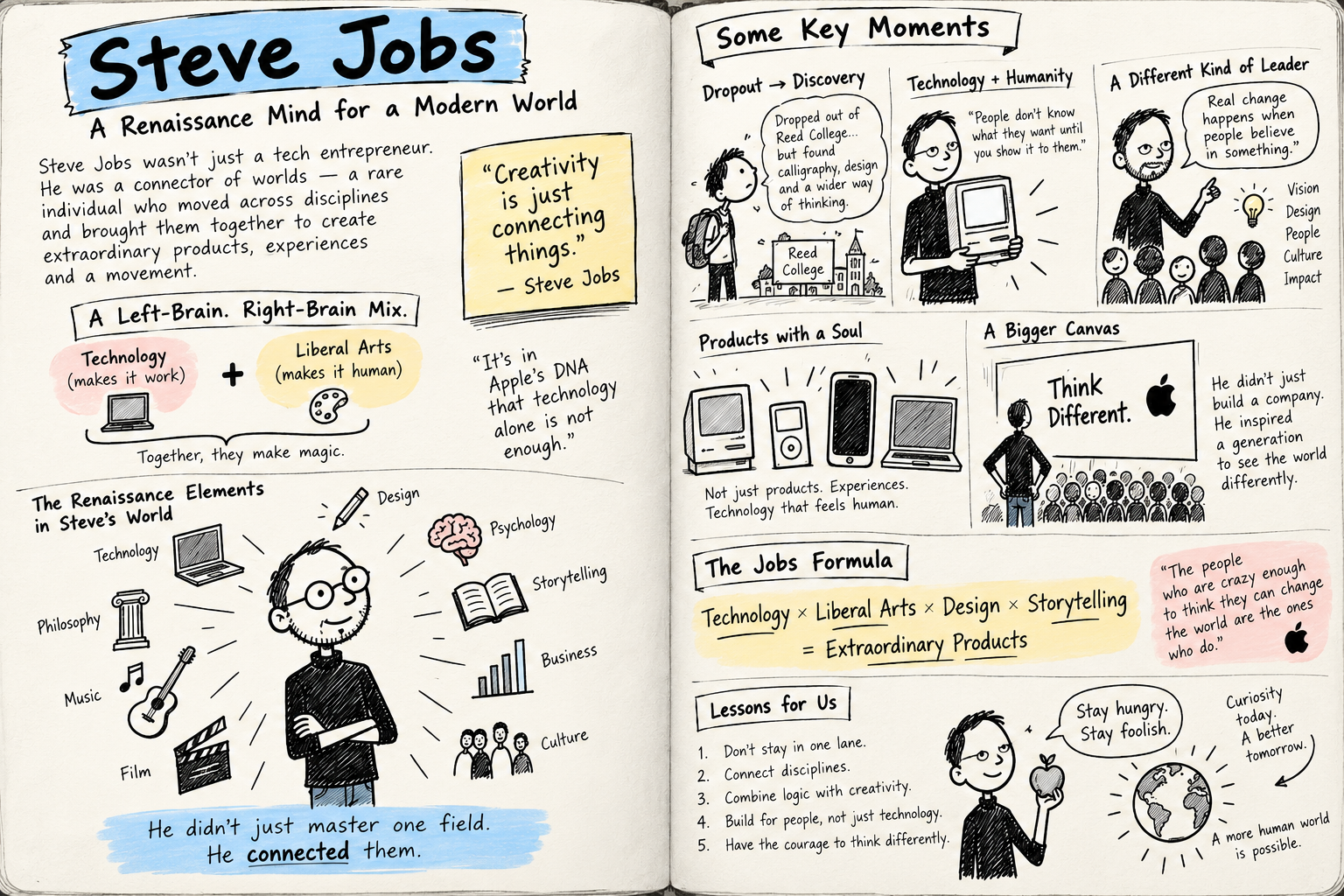
🏛️ Why “Renaissance” Is the Right Metaphor
The Renaissance produced thinkers who refused to stay inside disciplinary boundaries. Leonardo da Vinci could move between:
Steve Jobs brought a similar philosophy into Silicon Valley: computer science, industrial design, music, film, consumer technology, publishing, and human psychology. His genius was not simply knowing these fields. His superpower was connecting them.
🔥 The Jobs Formula
Technology × Liberal Arts × Design × Storytelling = Extraordinary Products
Jobs challenged the prevailing Silicon Valley assumption that the best technology would naturally win. His philosophy was closer to: Technology should disappear into the experience. The computer shouldn't feel like a computer. The phone shouldn't feel like a piece of telecommunications equipment. The product should feel intuitive, beautiful and inevitable.
🎨 From Engineering to Art
Jobs helped elevate design from decoration to strategy. The questions became:
This was a profound shift in Silicon Valley. Engineering built the machine. Design created the experience. Story created the meaning.
🎬 Pixar: The Unexpected Renaissance
At Pixar, technology became the medium for storytelling:
Toy Story demonstrated something extraordinary: the computer could become a canvas. Jobs became a bridge between Silicon Valley and Hollywood.
🧠 The “Connecting the Dots” Principle
One of the deepest lessons from Jobs's life is that innovation often comes from experiences that appear unrelated:
- →A calligraphy class → typography on the Macintosh.
- →Design → consumer electronics.
- →Music → iPod + iTunes.
- →Animation → Pixar.
- →Retail → Apple Stores.
The lesson for leaders: Don't only collect expertise. Collect experiences.You never know which two seemingly unrelated experiences will connect to create your next breakthrough.
⚔️ The Excalibur Leadership Lesson
Steve Jobs represents a powerful archetype for EXCALIBUR:
🧙 The Renaissance Leader
🏆 The Legacy
Steve Jobs didn't invent every technology inside Apple. That isn't the point. His contribution was orchestration. He brought together people, technology, design, culture, story, and business — and created products that changed how millions of people interacted with technology.
That is the Renaissance lesson. The next great leader may not be the person who knows the most about one field. It may be the person who can connect the most fields.
⚔️ Excalibur Takeaway
Steve Jobs = The Renaissance Leader of Silicon Valley
Leonardo asked: What can humanity create when art and science meet?
Jobs asked: What can technology become when engineering meets art, design and the humanities?
And Silicon Valley was never quite the same again.