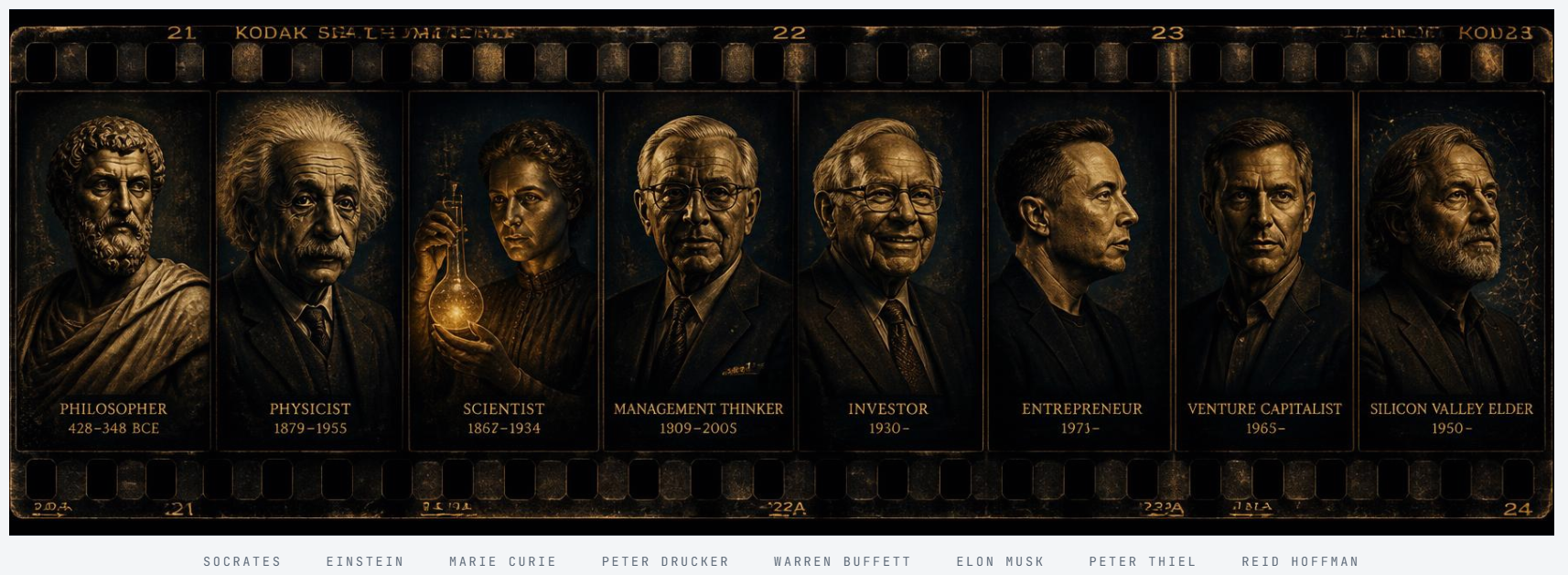
The material we return to when advising leaders across India — advisory scenarios and a working bibliography, kept here for reference.
01 / SCENARIOS
Six places where leaders come to us.
01
Founder-to-CEO
The psychological shift from building a product to architecting an institution — without losing the founding instinct.
A Parable
The Potter Who Would Not Leave the Wheel
Indian folk tale
A potter's pots were famous in seven villages, so buyers came from far away and the workshop grew. He hired twenty hands, yet every evening he sat back at the wheel himself, because only his thumb knew the true curve of a rim. In a year the workshop had one master and twenty pairs of idle hands, and the orders went unfilled. An old woman told him: your thumb made you famous, but only your teaching can make you large.
The MoralThe founder's gift becomes the company's ceiling the day it stops being taught and starts being hoarded.
02
Succession Planning
Continuity of vision across generations of leadership in family-led enterprises and promoter-driven boards.
A Parable
The Two Mango Saplings
Panchatantra, retold
A landlord planted a mango tree that fed his household for thirty summers, and each year he pruned it so it would bear more. His neighbour planted two saplings in the shade of his own tree and moved them into the light while he still had the strength to carry water. When the storm came, the first man's orchard ended with his tree; the second man's grandchildren argued happily about which mango was sweeter.
The MoralSuccession is not a document written at the end. It is water carried while you are still strong.
03
Crisis Navigation
Decisive action when the stakes are existential. Restoring public trust and re-aligning the internal coalition.
A Parable
Shackleton Turns the Ship Around
The Endurance expedition, 1915
When the ice crushed his ship, Ernest Shackleton stood on the floe and said quietly, "Ship and stores have gone — so now we'll go home." He abandoned the goal within the hour, kept the routine of meals and songs intact, and made himself boringly visible each day. Two years later every one of his twenty-seven men came home alive.
The MoralIn a crisis a leader changes the objective quickly and the rhythm slowly. Calm is a decision others can copy.
04
Scaling Friction
Resolving executive-team conflict and structural drag during periods of hyper-growth and capital pressure.
A Parable
The Bridge Builders of Ahmedabad
A merchant's account, retold
Two crews were paid to bridge the same river from opposite banks, each racing for the bonus. They built beautifully and fast, and met three metres apart in the middle, because neither had stopped to agree where the centre was. The merchant paid for a third crew to build the joint, and thereafter began every project with one question asked aloud: what exactly are we meeting at, and who owns that point?
The MoralGrowth rarely fails at the ends. It fails at the seams nobody was given to own.
05
Cultural Re-architecture
Re-grounding values after M&A, leadership change, or a public reckoning. Culture as operating system.
A Parable
The Emperor and the Seeds
East Asian folk tale
An ageing emperor gave every child in the province a seed and promised his throne to whoever grew the finest flower. On the appointed day the courtyard blazed with blossom, and one boy stood alone with an empty pot, ashamed. The emperor crowned him — the seeds had all been boiled, and only one child had refused to swap his for something that would look better.
The MoralCulture is not what the values poster says. It is what happens to the person who arrives with an empty pot.
06
Board & Promoter Dynamics
Navigating the unspoken contracts between founders, boards, investors, and the next generation.
A Parable
The King's Two Advisors
Hitopadesha, retold
A king kept two advisors: one who explained why each royal idea was brilliant, and one who asked what the kingdom would say about it in ten years. The first was pleasant company and was invited everywhere. When the treasury emptied, the king found that he had heard a thousand agreements and not one warning, and that he had promoted the wrong man to the room where it mattered.
The MoralA board's worth is measured in the questions it is permitted to ask, not the approvals it grants.
02 / THE ARCHIVE
Curated rigour for the Indian context.
The books, research, and programmes we return to when advising leaders across India. A working bibliography, updated quarterly.
Book/ Ram Charan
Execution: The Discipline of Getting Things Done
The seminal text on bridging strategy and operational reality, written by India's most globally cited management thinker.
Book/ Subroto Bagchi
The Professional
A meditation on what it means to lead with integrity in the Indian corporate context. Foundational for first-time executives.
Book/ R. Gopalakrishnan
The Made-in-India Manager
Why Indian leaders are over-represented in global C-suites — and what their formative wiring teaches about adaptive leadership.
Book/ Devdutt Pattanaik
The Leadership Sutra
An Indian framework for power, drawn from Devi mythology. Reframes authority through the lens of context and consequence.
Research/ Harvard Business Review India
The CEO Life Cycle
A longitudinal study on how CEO effectiveness changes year-on-year. Essential reading at the inflection points of tenure.
Research/ McKinsey India
The State of Organizations Report
Annual benchmark on organizational health across Indian enterprises — capability, culture, and decision velocity.